Process Optimization ( 2024 -2026 ) - Baker Hughes

Process Optimization is an AI-powered software application within the Baker Hughes Cordant™ suite. It is designed for the industrial sector to help them run their facilities at peak performance to achieve maximum production capacity.

Process Optimization is an AI-powered software application within the Baker Hughes Cordant™ suite. It is designed for the industrial sector to help them run their facilities at peak performance to achieve maximum production capacity.

Background Context

Baker Hughes targets industrial sectors such as oil, Fertilizer, chemicals, gas, etc. They were facing several operational challenges, for example, users manage thousands of sensors and valves to increase and stabilize production in their daily work. However, the dynamic changes in those sensors' parameters make it difficult for them to identify, due to fragmented data across multiple systems, or sudden asset shutdowns, and leave them no time to react.

That's where I stepped in with those ambiguous, uncertain situations.

Baker Hughes targets industrial sectors such as oil, Fertilizer, chemicals, gas, etc. They were facing several operational challenges, for example, users manage thousands of sensors and valves to increase and stabilize production in their daily work. However, the dynamic changes in those sensors' parameters make it difficult for them to identify, due to fragmented data across multiple systems, or sudden asset shutdowns, and leave them no time to react.

That's where I stepped in with those ambiguous, uncertain situations.

Baker Hughes targets industrial sectors such as oil, Fertilizer, chemicals, gas, etc. They were facing several operational challenges, for example, users manage thousands of sensors and valves to increase and stabilize production in their daily work. However, the dynamic changes in those sensors' parameters make it difficult for them to identify, due to fragmented data across multiple systems, or sudden asset shutdowns, and leave them no time to react.

That's where I stepped in with those ambiguous, uncertain situations.

My Role

I'm the lead designer, partnered with PM, TPM, SME, Data Scientists, and Developers.

Product Impact

Business Scalability

Accelerated multi-site deployment velocity by architecting a "zero-customization" UI framework, enabling rapid expansion from 1 customer to global enterprise clients.

Accelerated multi-site deployment velocity by architecting a "zero-customization" UI framework, enabling rapid expansion from 1 customer to global enterprise clients.

Efficiency

Achieved a 5–10x improvement in operational efficiency by standardizing complex unit-level data into a unified "Gap-to-Potential" dashboard.

Achieved a 5–10x improvement in operational efficiency by standardizing complex unit-level data into a unified "Gap-to-Potential" dashboard.

Performance

Measurable production gains, including a +0.8% daily yield increase by designing high-trust AI interfaces for real-time setpoint optimization.

Measurable production gains, including a +0.8% daily yield increase by designing high-trust AI interfaces for real-time setpoint optimization.

Interviewed with the customer and validated with SME & internal users, to build 3 role-based personas

3 personas are the operator, supervisor, and reliability engineer, it was built based on their different responsibilities, needs and wants, pain points and problems, and work environment. I worked closely with the PM & SME to ensure user workflows were connected while maintaining an independent workspace for each persona. 

3 personas are the operator, supervisor, and reliability engineer, it was built based on their different responsibilities, needs and wants, pain points and problems, and work environment. I worked closely with the PM & SME to ensure user workflows were connected while maintaining an independent workspace for each persona. 

💬

"I need the AI's recommendations on setpoints to be crystal clear. It helps me make faster decisions to maximize output, but I need to understand why it's suggesting that, to ensure safe operations first."

— Ethan, Panel Operator

"I need the AI's recommendations on setpoints to be crystal clear. It helps me make faster decisions to maximize output, but I need to understand why it's suggesting that, to ensure safe operations first."

— Ethan, Panel Operator

”I need deep-dive tools to analyze the gaps and run what-if optimization scenarios to prove that a tuning change is the right move.“

— Arthur, Process and Optimization Engineers

”I need deep-dive tools to analyze the gaps and run what-if optimization scenarios to prove that a tuning change is the right move.“

— Arthur, Process and Optimization Engineers

“My biggest pain point is tracking when and why we're missing optimization potential. My job isn't to look at a single valve, but to ensure the entire plan is actually implemented."

— Omar, Unit Supervisor

“My biggest pain point is tracking when and why we're missing optimization potential. My job isn't to look at a single valve, but to ensure the entire plan is actually implemented."

— Omar, Unit Supervisor

One of customers asked for a customized dashboard, but the product targets global industrial customers

A customized dashboard can't fit in common scenarios for global users

Our first customer is QAFCO, a Fertilizer company based in Qatar that produces ammonia. Due to their specialty, they require a customized dashboard with their own performance metrics.

Our first customer is QAFCO, a Fertilizer company based in Qatar that produces ammonia. Due to their specialty, they require a customized dashboard with their own performance metrics.

Conflicts while building the Information Architecture. I initiated the call with the team to finalize it

PM first suggested to mix the customized dashboard in the supervisor’s journey map, but I concerned the solution will cause more design efforts, dev efforts, and maintaining efforts in the future.

I drove the call with PM, TPM, Developers in the team, to solve our first customer's problem and be ready for future customer, seperated the workflows as an independed micro apps, only available for QAFCO.

PM first suggested to mix the customized dashboard in the supervisor’s journey map, but I concerned the solution will cause more design efforts, dev efforts, and maintaining efforts in the future.

I drove the call with PM, TPM, Developers in the team, to solve our first customer's problem and be ready for future customer, seperated the workflows as an independed micro apps, only available for QAFCO.

Outcome: Made the right decision by strategically thinking ahead

In 2025, another LNG company signed a contract for this product; they synced their data to the backend without breaking the current workflows or requiring design changes. Which means the decision saves extra business cost and efforts on the design and development side, making the product easier to manage and maintain the backend data.

In 2025, another LNG company signed a contract for this product; they synced their data to the backend without breaking the current workflows or requiring design changes. Which means the decision saves extra business cost and efforts on the design and development side, making the product easier to manage and maintain the backend data.

Build for Operator

Operator is the main persona for this product who use the software on day-to-day basis. Their responsibilities are make sure the assets running in a safe, reliable and efficient way, most importantly, increase the production as much as possible.

Operational constrains from downtime challenges to hidden parameter limits. I Streamlining complex production data into actionable real-time operator insights

Delayed data collection prevented operators from monitoring production performance mid-process. Operators were also struggling to manage different sensors for each asset, because the data is fragmented, some data from an Excel form, some just been told by an engineer over the phone. Consequently, production volume was frequently impacted by unforeseen asset shutdowns and technical parameter limits that remained invisible to the workforce. This created a significant gap between actual output and the facility’s true potential.

With the technical support, the system can obtain the real-time data on Actual production vs. target production. I designed the dashboard for the operator to monitor the entire facility's performance in real-time. Categorized asset details and designed the card-by-card to reduce the user’s cognitive load. Specifically, I designed 3 statuses for each asset, allowing operators to receive priority information at a glance. The next step was to design progressive disclosure to guide the user through completing the task on the side panel, and to optimize the decision path for a complex hierarchy with heavy data.

Build for Supervisor

Supervisor use the software weekly basis. They track the production gap and potential, set up the target and ensure the target are implemented. 

Supervisor use the software weekly basis. They track the production gap and potential, set up the target and ensure the target are implemented. 

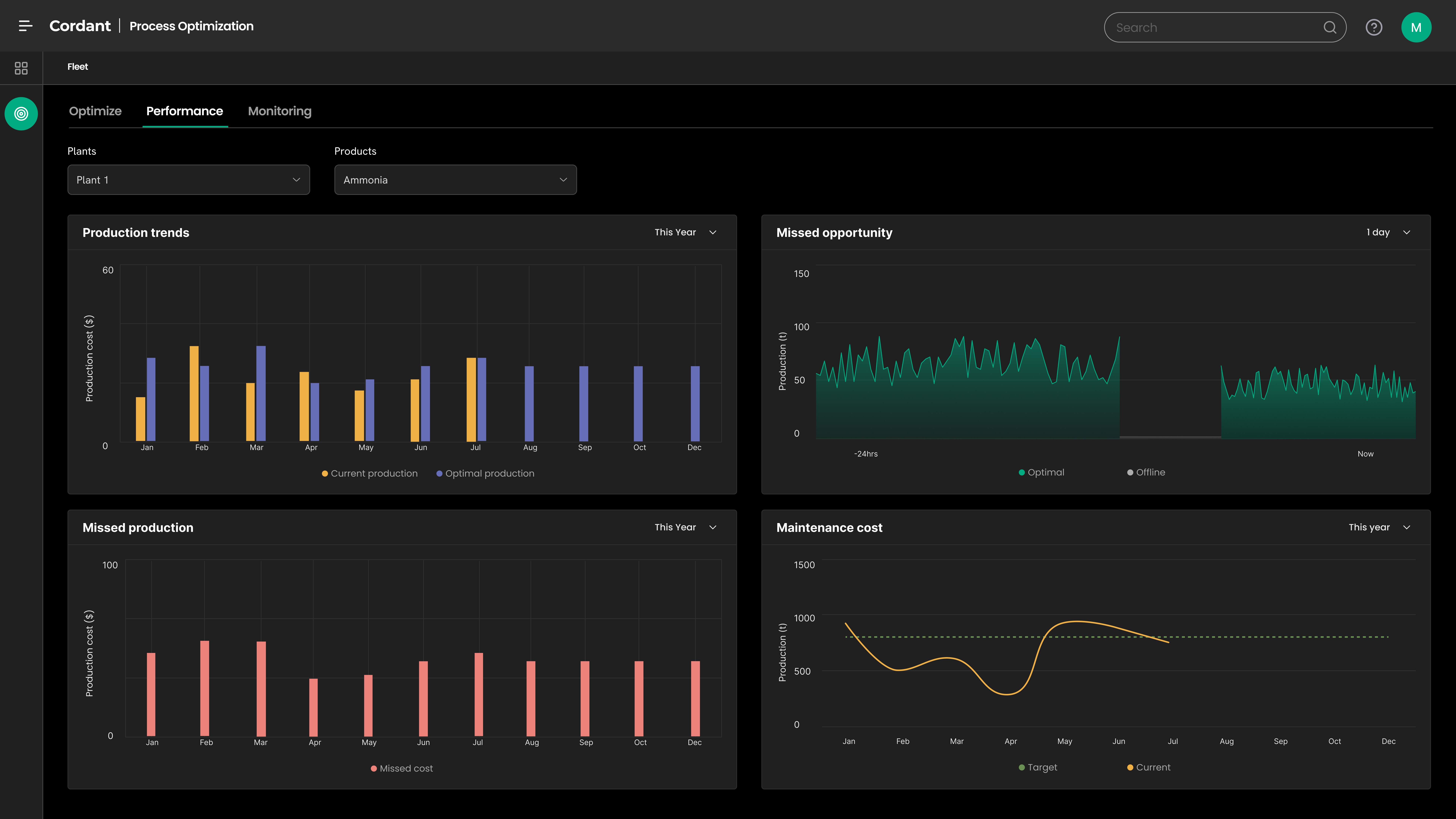
To reduce analytical friction from the manual Excel forms, I designed ways of tracking KPI with intuitive visual hierarchies

Tracking performance through raw numbers from an Excel form is a time-consuming task. I designed multiple charts to show whether the target was met. Simplify the facility hierarchy and make it easier to access data at the level-by-level.

Tracking performance through raw numbers from an Excel form is a time-consuming task. I designed multiple charts to show whether the target was met. Simplify the facility hierarchy and make it easier to access data at the level-by-level.

Build for Reliability Engineer

Engineers need this software weekly or monthly. Their daily routine is to run optimization scenarios and provide the operator with a safe suggested range.

Engineers need this software weekly or monthly. Their daily routine is to run optimization scenarios and provide the operator with a safe suggested range.

To close the information loop of the model deployment, I built a page that can help to visualize deployment trends and model comparisons

They leverage Machine Learning Models, train the data, run the simulation, and deploy the new model back to this system. However, there is no way to track the model's performance after deployment. To solve the problem of unpredictability and lack of visibility. I designed a left-to-right view that allows the user to locate the model they deployed and to monitor or compare performance trends across models.

They leverage Machine Learning Models, train the data, run the simulation, and deploy the new model back to this system. However, there is no way to track the model's performance after deployment. To solve the problem of unpredictability and lack of visibility. I designed a left-to-right view that allows the user to locate the model they deployed and to monitor or compare performance trends across models.

Even though I considered the operator work environment ahead. I still met the field reality problem after the customer applied the product in the operator room

Field reality revealed operators sit further back, splitting their attention across a 6-monitor setup, with the middle HD screen used for monitoring. With that in mind, I designed the Initial 1920px screen to use the largest fonts in our design system. However, the distance makes even the largest subheading unreadable.

Field reality revealed operators sit further back, splitting their attention across a 6-monitor setup, with the middle HD screen used for monitoring. With that in mind, I designed the Initial 1920px screen to use the largest fonts in our design system. However, the distance makes even the largest subheading unreadable.

Example of the Operator Room

I have to break the standards and Iterated the design by significantly scaling up font sizes and UI components. Sacrificed some screen density to guarantee immediate readability and reduce cognitive load during critical monitoring.

I have to break the standards and Iterated the design by significantly scaling up font sizes and UI components. Sacrificed some screen density to guarantee immediate readability and reduce cognitive load during critical monitoring.

Before

After

Problem always come with another problem.

After I scaled up the typography, the standard UI containers struggled with long industrial strings & numbers, causing text truncation and information loss during glance monitoring.

After I scaled up the typography, the standard UI containers struggled with long industrial strings & numbers, causing text truncation and information loss during glance monitoring.

So, for those of card with long name, I prioritized scanability by ensuring truncated card names are still glanceable. When needed, a slow horizontal scroll allows full visibility.

So, for those of card with long name, I prioritized scanability by ensuring truncated card names are still glanceable. When needed, a slow horizontal scroll allows full visibility.

AI chat assistance

The goal was to help all personas speed up their task on time.

Searching through heavy data is time-consuming for the operator who needs to take action immediately. instead of searching from level by level, product by product, they can just ask in the chart. The goal was to help all personas speed up their task on time.

Searching through heavy data is time-consuming for the operator who needs to take action immediately. instead of searching from level by level, product by product, they can just ask in the chart. The goal was to help all personas speed up their task on time.

I was focus on the information inputs & outputs

The internal product AI assistance, is not like Gemini or ChatGPT, you can ask whatever you want. So, I initiate a cross-function call, we were brainstorm the input&output and create some standards based on it, for example, If an operator asks for a assets production status, it returns a value card, if they ask for historical data, it generates a dynamic chart. That’s a basic logical for this conversation chart. 

The internal product AI assistance, is not like Gemini or ChatGPT, you can ask whatever you want. So, I initiate a cross-function call, we were brainstorm the input&output and create some standards based on it, for example, If an operator asks for a assets production status, it returns a value card, if they ask for historical data, it generates a dynamic chart. That’s a basic logical for this conversation chart. 

Users complain about the wait time while searching for answers. I suggest a sound notification to bring back the freedom to users

After the feedback collected from the usability testing session, I immediately suggested adding a clear UI indicator to show the loading process, instead of using that forever-loading spinner. Maybe a good try would be a countdown: 10, 9, 8…

❌ Unfortunately, that doesn’t work. There are technical feasibility issues to implement after I discuss them with the development team. 

✅ I came up with another solution: a sound notification. Tesla's approach inspired me. While you are waiting at a traffic light, once the light turns green, you can hear a sound like “ding.” So, I applied the same idea here: once the data is loaded successfully, the user can hear a sound of completion, and the user can do multiple tasks at the same time.

After the feedback collected from the usability testing session, I immediately suggested adding a clear UI indicator to show the loading process, instead of using that forever-loading spinner. Maybe a good try would be a countdown: 10, 9, 8…

❌ Unfortunately, that doesn’t work. There are technical feasibility issues to implement after I discuss them with the development team. 

✅ I came up with another solution: a sound notification. Tesla's approach inspired me. While you are waiting at a traffic light, once the light turns green, you can hear a sound like “ding.” So, I applied the same idea here: once the data is loaded successfully, the user can hear a sound of completion, and the user can do multiple tasks at the same time.

e.g, leverage AI chart assistance to quickly spot specific data points

💬 Quotes from the customer

"This initiative has fundamentally changed how we operate. The First principles and AI-based platforms have empowered our teams to make faster, smarter decisions, and the results speak for themselves. Through QAFCO’s Operational Excellence Program and our collaboration with Baker Hughes, we have elevated reliability across our assets. We’re building a culture of continuous improvement and innovation.”

— Abdulla Al Naemi, Head of Reliability Engineering, Qatar Fertilizer Company (QAFCO)

"QAFCO has achieved a +0.8% daily production uplift and saved over 500 hours of production downtime since November 2023. Leveraging Physics-based AI technologies and engineering domain expertise from Baker Hughes have set a new benchmark in process optimization and reliability. Our teams are fully engaged in this transformation to realize sustainable value at scale. This success is not just technological; it is the result of a robust change management approach that engaged leadership and empowered our teams at every level. Our partnership with Baker Hughes and our commitment to digital transformation enabled operational excellence has positioned QAFCO as a global leader in fertilizer production, delivering measurable and sustainable value for our stakeholders and the industry."

— Giuseppe Franceschini, Chief Technology Officer, Qatar Fertilizer Company (QAFCO)

💬 Quotes from the customer

"This initiative has fundamentally changed how we operate. The First principles and AI-based platforms have empowered our teams to make faster, smarter decisions, and the results speak for themselves. Through QAFCO’s Operational Excellence Program and our collaboration with Baker Hughes, we have elevated reliability across our assets. We’re building a culture of continuous improvement and innovation.”

— Abdulla Al Naemi, Head of Reliability Engineering, Qatar Fertilizer Company (QAFCO)

"QAFCO has achieved a +0.8% daily production uplift and saved over 500 hours of production downtime since November 2023. Leveraging Physics-based AI technologies and engineering domain expertise from Baker Hughes have set a new benchmark in process optimization and reliability. Our teams are fully engaged in this transformation to realize sustainable value at scale. This success is not just technological; it is the result of a robust change management approach that engaged leadership and empowered our teams at every level. Our partnership with Baker Hughes and our commitment to digital transformation enabled operational excellence has positioned QAFCO as a global leader in fertilizer production, delivering measurable and sustainable value for our stakeholders and the industry."

— Giuseppe Franceschini, Chief Technology Officer, Qatar Fertilizer Company (QAFCO)

💬 Quotes from the customer

"This initiative has fundamentally changed how we operate. The First principles and AI-based platforms have empowered our teams to make faster, smarter decisions, and the results speak for themselves. Through QAFCO’s Operational Excellence Program and our collaboration with Baker Hughes, we have elevated reliability across our assets. We’re building a culture of continuous improvement and innovation.”

— Abdulla Al Naemi, Head of Reliability Engineering, Qatar Fertilizer Company (QAFCO)

"QAFCO has achieved a +0.8% daily production uplift and saved over 500 hours of production downtime since November 2023. Leveraging Physics-based AI technologies and engineering domain expertise from Baker Hughes have set a new benchmark in process optimization and reliability. Our teams are fully engaged in this transformation to realize sustainable value at scale. This success is not just technological; it is the result of a robust change management approach that engaged leadership and empowered our teams at every level. Our partnership with Baker Hughes and our commitment to digital transformation enabled operational excellence has positioned QAFCO as a global leader in fertilizer production, delivering measurable and sustainable value for our stakeholders and the industry."

— Giuseppe Franceschini, Chief Technology Officer, Qatar Fertilizer Company (QAFCO)

Hi, I'm Miranda Liang

Work Experience :

5+ years

Domain :

User Experience Design

User Interface Design

Worked On :

Web & Mobile

B2B & B2C

Hi, I'm Miranda Liang

Work Experience :

5+ years

Domain :

User Experience Design

User Interface Design

Worked On :

Web & Mobile

B2B & B2C

Hi, I'm Miranda Liang

Work Experience :

5+ years

Domain :

User Experience Design

User Interface Design

Worked On :

Web & Mobile

B2B & B2C